The Trouble with Awareness
The false promise of raising awareness is predicated on a disavowal of social conflict


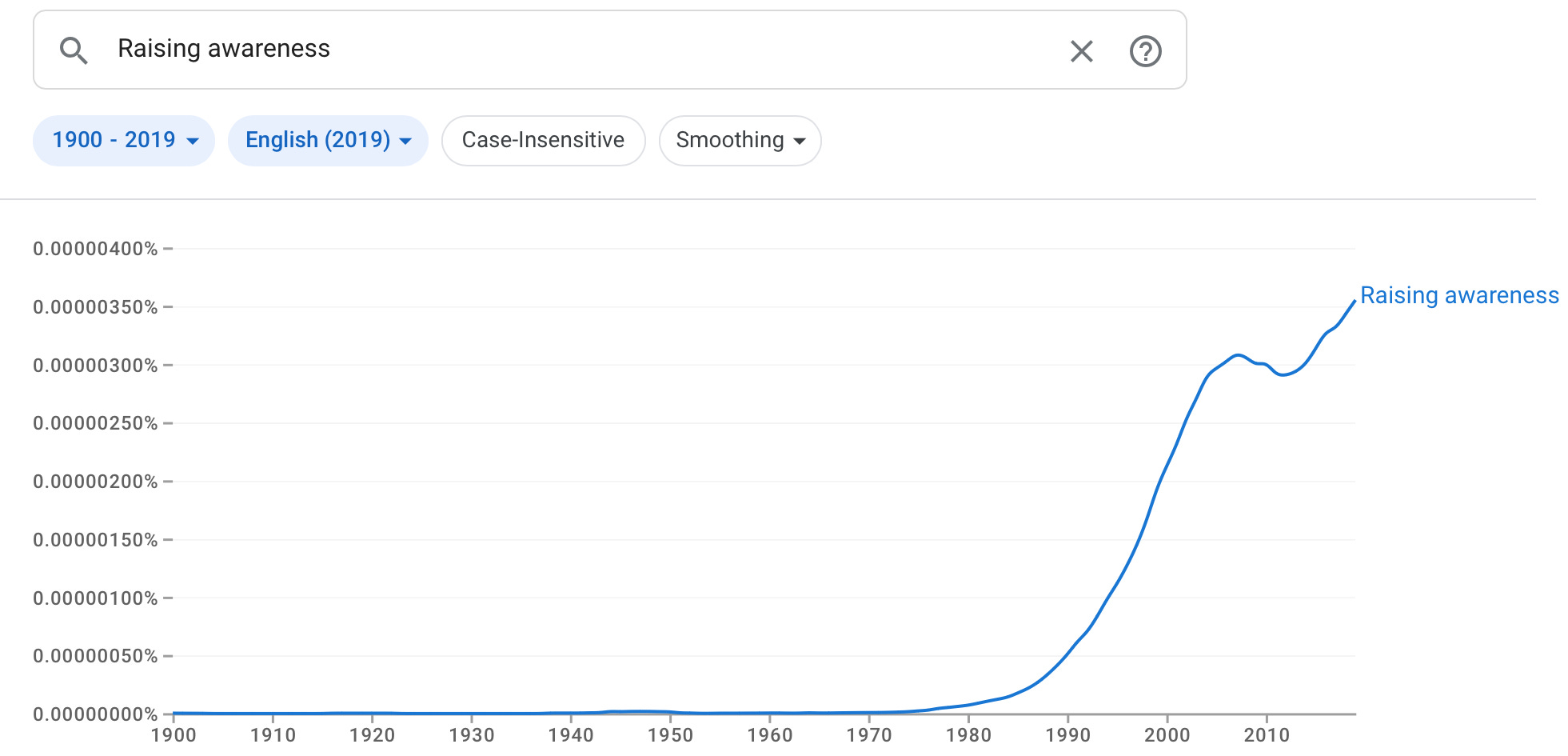
Raising Awareness is essentially the very simple idea that, ceteris paribus, the dissemination of facts and information will alleviate or do away with this or that societal ill. Society, in this view, is an aggregate of more or less informed choices of individuals, and the more informed they are, the better the outcome, an idea probably not by coincidence close to the idea of a market equilibrium. For what it’s worth, google ngram viewer shows a steep increase of usage of the syntagm since the early eighties, paralleling the rise of neoliberal hegemony.
But why would a well-informed populace come to unanimous conclusions, unless you suppose that the interests of said populace are more or less harmonious? And because they are patently not, contrary to the posthistoricist1 fantasy, people do indeed draw a wild array of conclusions from the facts presented to them.
Take climate change: For a radical, climate change presents the necessity of eco-socialist2 transformation, for a capitalist, an opportunity to sell electric cars, for a government, an opportunity to gain independence from geopolitical rivals, for a professional-managerial class liberal, a task in behavioural management, and so on. For the average Joe who needs to commute to work by car from the periphery, it might not even present any meaningful task at all, because of the nature of the pitiful means at his disposal, and the extremely limited temporal and spatial reach of what little agency he has.
None of these results are necessarily due to a lack of information, as the information deficit model would have it, nor necessarily due to incompetence in didactics and framing. Facts simply do not straightforwardly imply a course of action to the subjects they are presented to. That’s a matter of their interests, their objectives, and the resources they have access to. For the activist, however, the stubbornness of his imagined audience can only be the result of ignorance, and consequently, a legitimation of their heroic task: to raise even more awareness. The necessary frustration of this project, far from raising doubts about its efficacy, only gives it more fuel. From the point of view of the stated objectives of climate activists, addressing an abstraction like humanity might amount to little more than screaming into the void; but it does cater to the psychological need for ethical immediacy.3
Raising awareness about an issue will amount to little more than this issue being handled and managed by the powers that be, and with the catastrophic results to be expected from said management - and this isn’t due to ignorance on their part, but due to the nature of their interests. The ideology of awareness consists in bypassing the need for the creation of a new political subject that could seriously confront these powers - and this is its usefulness.
Walter Benn Michaels’ formula for what is arguably still our ideological horizon, see ibd., The Shape of The Signifier.
Yet another hyphenated socialism which strikes me as redundant.
See Mark Fisher, Capitalist Realism, p.15.
Another day another banger.